

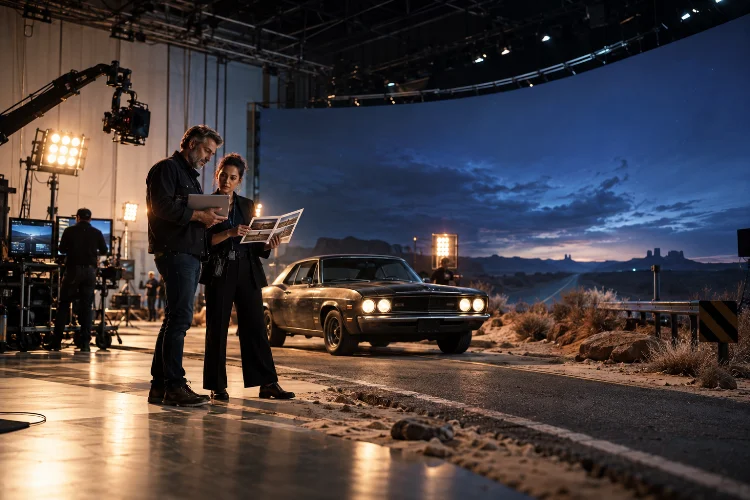
A desert highway at midnight sounds simple on the page. Then someone prices the road closure, weather cover, hotel rooms, stunt support, and three extra nights of shooting. Suddenly, the scene that felt inexpensive in the writers’ room looks like a financial cliff.
Could an LED volume solve it? Maybe. But switching to virtual production also brings digital environment builds, tracking equipment, specialist crews, and stage fees. And a green screen might be cheaper still, provided the compositing work doesn’t balloon after the shoot.
That’s why cost modeling for hybrid virtual and practical film production is becoming an essential skill for producers.
Rather than treating virtual and physical filmmaking as rival camps, a hybrid budget asks which approach delivers each shot at the best balance of cost, quality, schedule, and risk.
The trick is to measure the finished sequence, not just the day rate. This guide covers comparable cost categories, realistic scenario planning, hidden expenses, schedule dependencies, and a simple way to monitor estimates against actual spending.
You’ll finish with a framework that supports creative decisions without pretending every film needs the same technical solution.
1. Start With the Scene, Not the Technology
Break the script into comparable deliverables
Before building a cost model, decide exactly what the crew needs to capture. A dialogue scene inside a parked car, a rooftop chase, and a wide shot of a spaceship hangar may require completely different combinations of location work, physical scenery, real-time backgrounds, and conventional VFX.
Create a shot-level breakdown that notes camera movement, cast action, reflective surfaces, environment scale, time of day, and the amount of background visible. Then give each sequence a small set of plausible production methods. Consider location, green screen, LED volume, or a mixture.
Compare equivalent creative results. A studio close-up cannot replace a crane shot if the director needs that movement. Match performance, safety, and delivery standards before comparing dollars.
Understand what each method moves downstream
Location shooting pays for access to a real environment but may expose the production to travel, weather, permits, and company moves. Green screen can simplify the shoot while pushing background creation, keying, lighting integration, and revisions into post-production.
An LED volume brings some of that work forward: backgrounds often need to be camera-ready before filming, supported by tracking, rendering, and synchronization.
Epic Games’ in-camera VFX documentation makes clear that the technology is an interconnected production system, not merely a wall displaying pictures.
That difference in timing matters as much as the price tag. A method with the smallest shooting invoice may still be the most expensive way to deliver the final scene.
2. Build a Full-Cost Model Across Every Department
Capture costs that appear before the camera rolls
Start with prep, creative development, and asset production. Include previs, technical scouting, environment capture or modeling, virtual art department labor, physical set drawings, construction tests, lens calibration, and camera-to-display rehearsals. Shared expenses still need to be accounted for.
For physical work, include locations, permits, transport, accommodation, sets, and weather protection.
For LED shooting, request itemized quotes for panels, stage space, tracking, rendering systems, technicians, power, prelight, load-in, and strike. Ask what is included rather than assuming a quoted volume rate covers everything.
Add labor, post-production, and completion
Crew hours, overtime, fringes, insurance, equipment, production management, editing, VFX finishing, cleanup, color, and delivery can change between approaches.
Conventional compositing might be heavier on a green-screen sequence; an LED shot may still need seam removal, set extensions, or a replacement background. Don’t set post to zero because someone calls the captured image “final pixel.”
Use a consistent chart of accounts so the same expense doesn’t vanish or appear twice. Wrapbook’s budgeting guidance separates production, post, above-the-line, and other expenses; the principle is useful even when a studio’s internal categories differ.
A working formula is total modeled cost = prep and assets + production + travel and logistics + post and delivery + expected risk cost. Keep common costs visible elsewhere in the master film budget, even if you exclude them from a sequence-level comparision because they are identical across options.
3. Compare Three Production Scenarios With Real Math
A fictional night-driving sequence
Imagine a feature needing three nights of dialogue inside and around a moving car. The director wants wet-road reflections, a convincing city skyline, and occasional exterior angles.
The producer is considering a practical night shoot, green screen with compositing, and a hybrid option using an LED wall for interiors plus a limited practical exterior unit.
These are hypothetical US-dollar figures, not vendor quotes or market rates. Shared film-wide expenses are excluded.
| Cost category | Practical location | Green screen | Hybrid LED + practical |
|---|---|---|---|
| Prep and digital assets | $8,000 | $17,000 | $30,000 |
| Shoot, stage, and crew | $49,000 | $32,000 | $49,000 |
| Travel, permits, logistics | $19,000 | $4,000 | $3,000 |
| Post and VFX finishing | $14,000 | $33,000 | $9,000 |
| Base sequence cost | $90,000 | $86,000 | $91,000 |
| Expected risk cost | $9,000 | $8,000 | $4,000 |
| Modeled expected total | $99,000 | $94,000 | $95,000 |
Read the results without overselling them
The green-screen approach wins this particular base-case comparison by $1,000 against hybrid when expected risks are included.
That’s hardly a landslide. If the post schedule is unusually tight, or the car’s glass produces difficult reflections, the hybrid option might earn its slightly higher modeled cost.
Expected risk cost is calculated as probability multiplied by the extra cost if something happens.
Here, the location option assumes a 30% chance of a $30,000 disruption; green screen assumes 40% of a $20,000 revision; hybrid assumes 25% of a $16,000 technical or pickup problem. These are invented assumptions that should be replaced with production-specific evidence.
An expected value isn’t a cash reserve. Producers still need enough contingency and liquidity to survive a bad outcome, not just its statistical average. Most importantly, the model doesn’t tell the director which image is best; it tells the team what each creative choice is likely to cost.
4. Model Scheduling, Capacity, and Break-Even Points
A cheaper day can make a more expensive week
Budget comparisons often fail because they ignore timing. A location may require two travel days and an extra night crew, while an LED volume may need several prelight and calibration days before the first paid take. Both affect the critical path, even when those days sit in different cost reports.
Build a dependency schedule showing when digital backgrounds, practical construction, camera tests, and final approvals must be finished.
Ask what happens if one milestone slips. An unfinished environment can leave an expensive stage idle; a delayed permit can strand an entire location unit.
Calculate the incremental cost of a lost day: crew and cast extensions, stage or location fees, equipment rentals, transport, and any overtime or schedule ripple effects.
A $15,000 daily facility quote may represent a much larger all-in exposure once people and equipment are included.
Find the reuse threshold
Digital environment reuse is where a hybrid pipeline may become more attractive. Suppose a reusable environment costs $36,000 to build, compared with $9,000 for a one-off practical background preparation.
If each additional LED sequence avoids $7,000 in location or post costs, the extra upfront investment is $27,000, and the simple break-even point is roughly four sequences ($27,000 ÷ $7,000 = 3.86).
That’s a directional calculation, not a complete financial verdict. Reuse still needs new dressing, testing, performance optimization, and sometimes licensing approval. Track those incremental expenses and only credit savings where future sequences are reasonably likely to happen.
5. Stress-Test Risk Instead of Hiding It in Contingency
Build scenarios around uncertainty
No estimate is perfect, especially when a crew is mixing unfamiliar technology with physical effects. Replace a single optimistic budget with at least three views: a base case, a favorable case, and a downside case.
Adjust actual drivers such as asset-revision days, stage utilization, weather delays, and compositing shot complexity rather than adding an arbitrary percentage to everything.
A sensitivity test can be surprisingly revealing. If the hybrid plan adds one $18,000 all-in volume day, its $95,000 expected total rises to $113,000. If the green-screen plan needs another $25,000 of cleanup work, its $94,000 estimate becomes $119,000. The preferred option changes with the assumptions.
Identify who owns each risk and what decision would trigger a change of method. A location could handle wide action while LED carries close-ups.
Budget technical testing as insurance against rework
Camera tracking errors, moiré, shutter-sync problems, reflections, color mismatch, and render-performance drops can all damage the schedule. Test representative lenses, movements, lighting setups, and environments before committing to the most expensive shooting days.
Research on virtual production has highlighted the cost and accessibility barriers of LED infrastructure, particularly for smaller productions.
That makes a paid proof of concept a rational budget line rather than a luxury. A modest test can reveal whether projected savings survive contact with the actual camera.
6. Account for Cash Flow, Incentives, and Shared Assets
Separate total cost from the timing of cash
An LED strategy often requires spending on asset development and stage reservations earlier than a conventional post-heavy plan.
Two options with similar total budgets can create very different cash-flow pressures. Map when deposits, crew payments, vendor invoices, and final VFX balances actually become due.
Production accounting needs regular forecasts, not just a greenlit budget that sits untouched. Wrapbook’s cash-flow guidance emphasizes that a production must have funds available when expenses occur.
Negotiate milestone payments where appropriate, and don’t rely on anticipated financing as if it has already arrived.
Treat tax incentives and reuse carefully
A regional incentive may apply differently to stage fees, local crew, digital work, and out-of-territory vendors. Compare alternatives first on gross qualifying costs, then assess incentives using current local rules and professional advice.
Never subtract a rebate from spending that doesn’t qualify, or assume its payment date matches the shoot schedule.
If a studio shares a digital city across episodes or productions, allocate the original asset cost using a documented method.
Keep maintenance, modifications, storage, software, and ownership rights in view. The first film shouldn’t recieve all the apparent savings while the next production quietly absorbs every upgrade.
Environmental effects deserve a separate line of analysis too. Sony has published an illustrative comparison suggesting virtual production can reduce emissions relative to location work under specified assumptions, but that does not automatically mean a lower financial cost. Measure travel, energy, material use, and vendor rates independently.
7. Turn the Model Into a Live Production-Control Tool
Compare the estimate with money actually committed
A spreadsheet isn’t finished at presentation. Update forecasts as bookings, contracts, and final VFX bids arrive. Record budget, commitments, actual spend, and estimate-to-complete for each sequence, then roll them into an estimate-at-completion.
Set review points at technical lock, prelight, the end of each shooting block, and early post-production.
If asset costs rise while expected post savings shrink, ask whether the remaining shots should move to a different method. These choices are much easier before a nonrefundable stage booking or irreversible set build.
As Wrapbook’s guidance on budget actualization shows, collecting real expenses in the same coding structure as the budget makes overruns easier to identify. The useful question isn’t simply “Are we over budget?” It’s “Which assumption changed, and what can we do while there’s still time?”
Build a feedback loop for the next film
After delivery, compare modeled and actual results. Note how many virtual backgrounds were reused, how many stage hours were productive, which shots required post fixes, and which location risks actually materialized. Record the cost of delays alongside the creative outcome, not just the final invoice.
Over several productions, this history becomes a studio-specific estimating library. One team may find LED ideal for car interiors but unsuitable for large fights; another may favor physical sets when scripts change late. The goal is better descisions, not universal rules.
Hybrid production works best when producers stop asking whether virtual filmmaking is cheaper and start asking which combination makes each finished sequence achievable.
A useful cost model compares equivalent shots, captures expenses across departments, accounts for when money must be spent, and makes uncertainty visible rather than burying it.
The biggest savings often come from choosing the right method early, scheduling specialist work carefully, and reusing assets where the economics genuinely support it.
Just as important, a strong model leaves room for artistic judgment: the cheapest version of a scene isn’t automatically the most compelling.
Before your next production meeting, select one complex sequence and price three realistic approaches. Get actual vendor bids, run a downside scenario, and revisit the numbers as the shoot approaches. That’s how a hybrid pipeline becomes a creative advantage instead of an expensive experiment.